
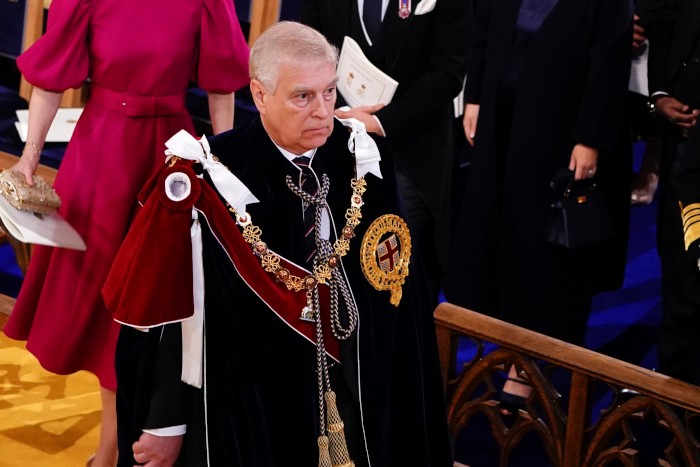
There is much discussion in the mainstream media and amongst the alternative media in cyberspace about the man currently styled as “Prince Andrew” being formally deprived of his peerages and princely titles and styles and his membership of orders of chivalry.
In respect of his princely titles and styles and his membership of orders of chivalry; these can be removed by the King by decree. In respect of his peerages, an Act of Parliament is required.
Certain important FACTS must be considered:
To date Prince Andrew has not been convicted of a criminal offence – nor has he been charged with one, nor has he been arrested on suspicion of committing one. Therefore for Parliament to legislate to remove his three peerages would be an act of constitutional miscarriage of justice.
However, there is a clear interest – in respect of maintaining popular support for the monarchy that Prince Andrew be deprived of the peerages.
There is a solution:
To amend the Peerages Act, 1963.
It is a fairly brief act that has already been amended by the Parliament Act, 1999.
I have copy and pasted the text below with my suggested alterations using the “strikeout” and “bold” attributes both or which are self explanatory.
TEXT: 1 Disclaimer of certain hereditary peerages.
(1) Subject to the provisions of this section, any person who, after the commencement of this Act, succeeds to a peerage in the peerage of England, Scotland, Great Britain or the United Kingdom may, by an instrument of disclaimer delivered to the Lord Chancellor within the period prescribed by this Act, disclaim that peerage for his life.
(2) Any instrument of disclaimer to be delivered under this section in respect of a peerage shall be delivered within the period of twelve months beginning with the day following on which the person disclaiming succeeds to that peerage or, if he is under the age of twenty-one when he so succeeds, the period of twelve months beginning with the day following on which he attains that age; and no such instrument shall be delivered in respect of a peerage by a person who is excepted from section 1 of the House of Lords Act 1999 by virtue of section 2 of that Act.
(3) The foregoing provisions of this section shall apply to a person who has succeeded to a peerage before the commencement of this Act as they apply to a person who succeeds to a peerage after the commencement of this Act, but subject to the following modifications:—
(a) the period within which an instrument of disclaimer may be delivered by such a person shall be twelve months beginning with the commencement of this Act or, if he is then under twenty-one years of age, twelve months beginning with the day on which he attains that age;
(4) In reckoning any period prescribed by this section for reference to the delivery of an instrument of disclaimer by any person no account shall be taken of it any time during which when that person is shown to the satisfaction of the Lord Chancellor to have been subject to any infirmity of body or mind rendering him incapable of exercising or determining whether to exercise his rights under this section.
(5) The provisions of Schedule 1 to this Act shall have effect with respect to the form of instruments of disclaimer under this section, and the delivery, certification and registration of such instruments.
A new Section 3: If a peer who has reached the age of twenty-one is convicted of a criminal offence, the judge may issue a requirement to disclaim his peerage or peerages in in addition to or in substitution of another penalty.
Sections 6 & 7 unamended.
Source: https://www.legislation.gov.uk/ukpga/1963/48
British Gazette comment: This amendment could be quickly legislated in a couple of days given the necessary cross party support. It would enable Prince Andrew to disclaim his peerages and be formally relieved of his membership of the two orders of chivalry and would enable him to take up residence in his palace in Abu Dhabi as Mr Andrew Mountbatten-Windsor.